A Classical Curriculum Series

Classical literature.
Sound money.
Families who ask why.

A curriculum series rooted in the Trivium, built on public domain literature, and designed to teach Austrian economics to students from age six to seventeen — simultaneously.

Lewis Carroll was a mathematician. He hid the most important economics lesson of the twentieth century inside a fairy tale.
We found it.

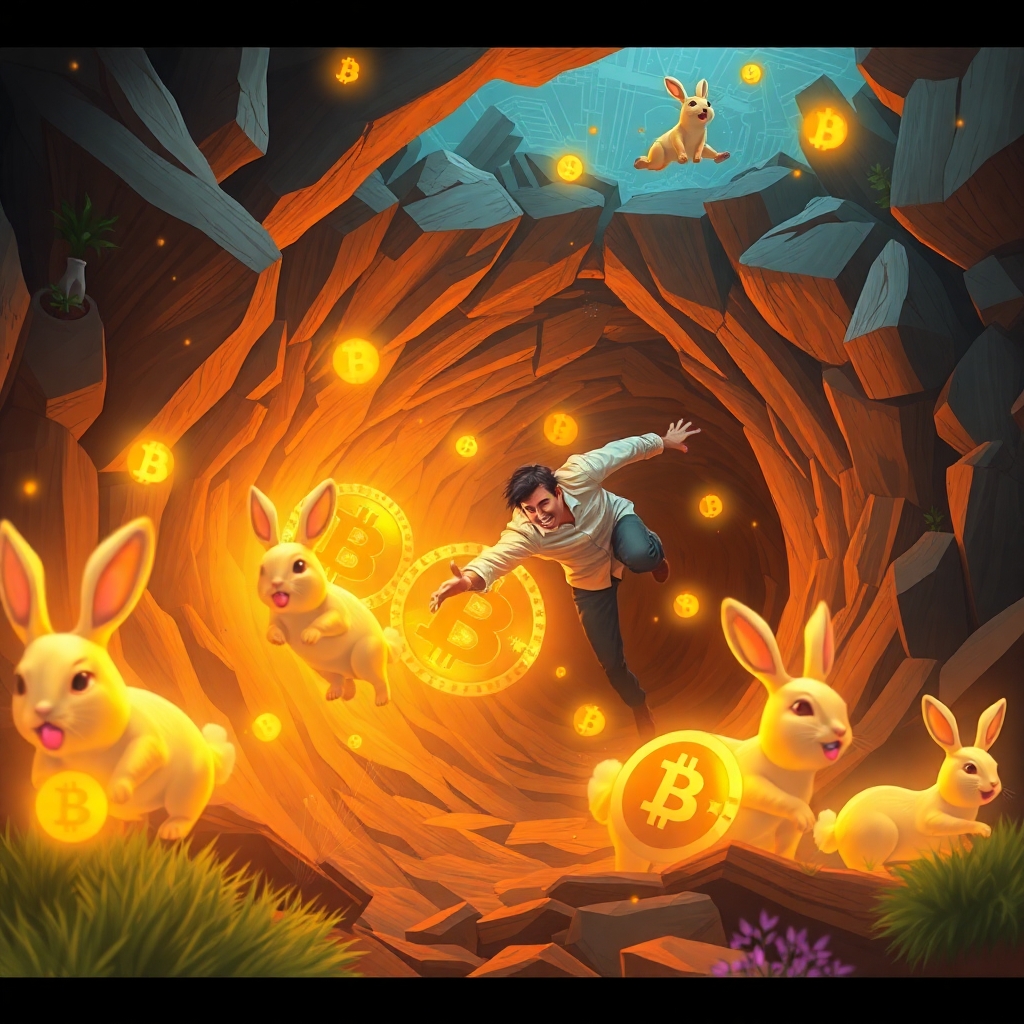
A man chasing glowing Bitcoin rabbits into a massive rabbit hole

Follow the question all the way down the rabbit hole.


How It Works

One family. One lesson.
Every age at once.

The curriculum is built on the classical Trivium — the three-stage model of learning that has produced rigorous thinkers for a thousand years. One parent teaches all three levels simultaneously from a single Teacher's Guide.

I
Grammar Stage
Ages 6–9 · Grades 1–5

Memory work chants and bedtime read-alouds plant foundational images. Scarcity, barter, and the basic properties of sound money — embedded in the story, not explained over it.

II
Logic Stage
Ages 10–14 · Grades 6–8

Socratic discussion questions with no trick answers. Cause and effect. Fiat inflation, central banking, and the necessity of rules that cannot be changed by royal decree.

III
Rhetoric Stage
Ages 14–18 · Grades 9–12

Written and oral arguments on genuinely contested questions. Austrian theory, praxeology, time preference, and the business cycle — debated, not delivered.


The Series

Public domain literature.
Timeless economic ideas.

Every title in the Classical Bitcoin series begins with a story in the public domain — literature that has already proven it can hold a child's attention for a century or more. The economic ideas were always there. We follow them out.

Available Now
Book One

Alice in Bitcoin Land

Sound Money · Fiat Critique · Rules vs. Decrees

Wonderland runs on arbitrary rules enforced by theatrical authority. Bitcoin runs on mathematics. Carroll's logic puzzle, reclothed for the question every parent should be able to answer: what would it mean for money to have rules that nobody could change?

Coming Soon
Book Two

A Christmas Carol
and the Cost of Tomorrow

Time Preference · Capital · Charity vs. Welfare

Scrooge is not simply a miser. He is a lesson in time preference — and his transformation is the most vivid illustration of capital accumulation in all of Victorian literature. Dickens knew something Keynes did not.

Coming Soon
Book Three

The Wizard of Oz
and the Gold Standard

Gold Standard · Populism · Illusion of Central Power

L. Frank Baum wrote his story in 1900, at the height of the silver vs. gold monetary debate. The yellow brick road was never just a road. Dorothy was never just a girl from Kansas.

The Argument

Why Carroll. Why now.

"Carroll was a mathematician at Christ Church Oxford. He did not write nonsense. He wrote logic wearing a costume — because logic in a costume is something a child will follow all the way to the bottom of the argument."

There is a story economists tell about a problem that cannot be solved from the top down. Friedrich Hayek called it the Knowledge Problem. Lewis Carroll dramatised it in 1865, in a story about a girl at a tea party where time had stopped and nobody could explain why — except that it had always been this way and questioning it was not encouraged.

Dorothy Sayers stood at Oxford in 1947 and called for a return to teaching children not what to think, but how. She was describing what Carroll had already done. She was also describing, without knowing it, what a small group of economists had been doing since the 1870s in Vienna.

This curriculum sits at the intersection of those three traditions. The goal is not a student who knows about Bitcoin. The goal is a student who knows how to follow a question all the way to the bottom — and come back changed.

Lewis Carroll Dorothy Sayers Carl Menger Friedrich Hayek Ludwig von Mises Murray Rothbard
Join the List

Be the first to know
when Book One ships.

No noise. No politics. Just curriculum updates, early access to new titles, and the occasional essay worth reading.

Your inbox is not Wonderland. We will not change the rules on you.